

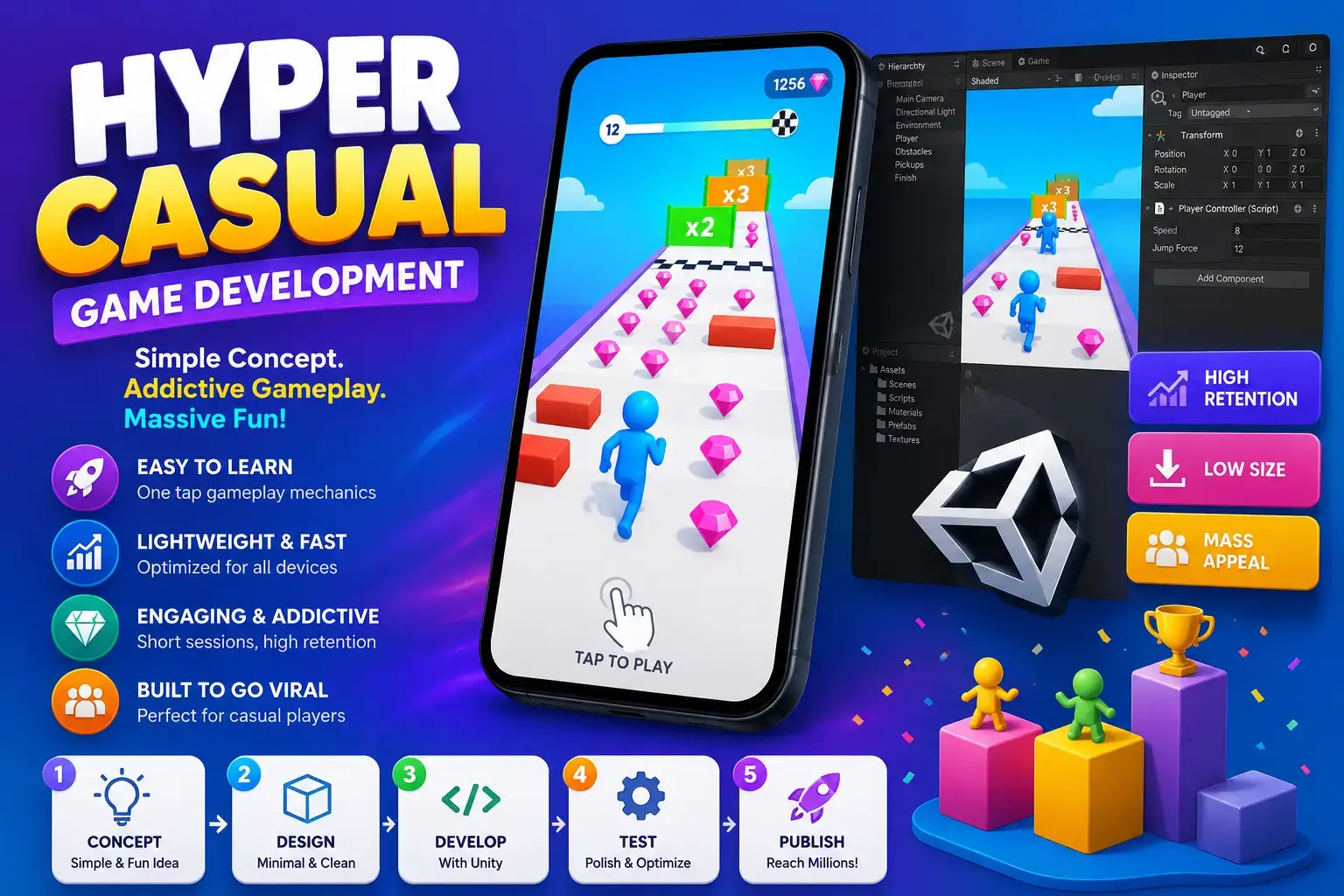
Hyper Casual Game Development: Complete Guide for Unity Game Developers (2026)
Introduction
The popularity of hyper casual games is one of the main innovations in the gaming industry that has revolutionized the approach to game development and mobile entertainment in general. As of 2026, hyper casual games continue to be extremely popular among gamers as they attract numerous users, receive millions of downloads, and provide good potential for making money through advertisements. In this regard, creating hyper casual games has become one of the quickest ways for contemporary developers to join the gaming market.
Unity game development can easily handle all stages of creating hyper casual games due to their user-friendly interface, fast development process, and powerful optimization features. From endless runners to stackers, puzzles, and physics-based arcade games, Unity can be successfully applied to all types of games mentioned above.
Speed is one of the best advantages of the process of hyper casual game development. The developers can create prototypes, test gameplay, and successfully convert them into high-quality mobile games. All this in combination with such factors as monetization via ads and low production expenses makes hyper casual games appealing for both indie developers and established studios.
Here, in this ultimate guide, you will find all the information necessary for the development of hyper casual games on the basis of Unity, including simple mechanics, quick prototyping, ad monetization, optimization, publishing, and more.
What Are Hyper Casual Games?
Hyper casual games refer to lightweight mobile games which have the following characteristics:
- Easy controls
- Minimalistic graphics
- Short gameplays
- Instant engagement
- Easy mechanics
These games are made for downloading millions of times by players.
Common types of hyper casual games include:
- Endless run games
- Stack games
- Puzzle physics games
- Tap games
- Obstacle games
- Merge games
Games are developed in such a way that players will be able to grasp its gameplay in seconds.
Why Is Unity Good for Hyper Casual Games?
Unity has become a choice of many game developers when developing hyper casual games.
Reasons Why Unity Is a Good Choice for Hyper Casual Games
- Fast development
- Multiple platforms
- Easy mobile deployment
- Asset store
- Lightweight performance tools
- Monetization tool built-in
- User-friendly UI
Unity makes the work of hyper casual game developers easy.
Trending Simple Game Mechanics in 2026
Simple game mechanics play a key role in developing hyper casual games successfully. Ideally, these mechanics should be easy to learn, but difficult to master.
1. Tap-To-Play Mechanics
Tapping is a very successful hyper casual game style.
Examples:
- Jumping games
- Timing challenges
- Flappy-like games
- Rhythm games
Why it works:
- One-touch control
- Easy to pick up
- Replayable
2. Endless Runner Mechanics
Endless runner games are dominating mobile gaming today.
Key features:
- Unlimited progression
- Obstacle dodging
- Dynamic speed
- Swipe controls
They are repayable and good for ads.
3. Stack and Balance Mechanics
The player stacks objects or balances them.
Examples:
- Tower stacking
- Bridge building
- Balancing
It works well as an engaging game mechanic.
4. Physics-Based Gameplay
Games using physical interactions are interesting and unpredictable to play.
Most common mechanics include:
- Ragdoll
- Destruction
- Bounce physics
- Projectile shooting
The Unity engine has its own physics system for ease of use.
5. Merge Mechanics
Merge games remain popular for being simple yet offering progression.
Examples:
- Merge numbers
- Merge vehicles
- Merge guns
- Merge characters
Such mechanics lead to long sessions and retention.
6. Obstacle Dodge Mechanics
Players dodge obstacles to move further in levels.
Why it works:
- Fast-paced gameplay
- Simple controls
- Challenging
This mechanics is common for arcades and hyper casual games.
Fast Prototyping in Unity
Importance of Fast Prototyping
Timing is essential for developing hyper casual games. The process involves trying out many concepts and finally choosing an idea that will scale well.
The importance of fast prototyping includes:
- Validating gameplay
- Reducing cost of development
- Increasing iteration speed
- Testing marketability
Unity is ideal for fast prototyping of hyper casual games.
Guidelines for Fast Prototyping
1. Start with Core Gameplay
Only include:
- Core gameplay mechanic
- Basic controls
- Win and lose criteria
It is not necessary to add additional gameplay elements at the beginning.
2. Incorporate Placeholder Assets
Assets designed as placeholders speed up the development process.
For instance:
- Basic shapes
- Free Asset Store assets
- Basic UI elements
Polishing visuals comes much later once the concept of the game is validated.
3. Utilize Modular Architecture
This enhances efficiency during development.
Example:
- UI components
- Input system
- Level generation system
- Advertisement integration module
Modular architecture facilitates efficient development in future projects.
4. Leverage Unity Asset Store Resources
The Asset Store allows developers to save time in game development significantly.
Example asset types to utilize:
- Hyper casual game templates
- UI kits
- Mobile shaders
- Sound packs
- Ad SDK integrations
The use of game templates enables developers to release games sooner.
5. Test Games Frequently
Frequent testing helps identify:
- Playability issues
- Retention problems
- Balancing monetization
- Performance problems
Rapid iteration is crucial for hyper casual game development.
Tips on Mobile Optimization for Hyper Casual Games
Optimization is important since hyper casual games run on numerous mobile devices.
1. Avoid Draw Calls
Draw calls may affect the game's performance.
Methods of optimization:
- Sprite atlas
- Mesh combining
- Batching
These techniques ensure that FPS and energy efficiency will be increased.
2. Optimize Textures
Using large textures consumes more RAM.
Solutions include:
- Texture compression
- Resolution reductions
- Optimization of sprite dimensions
3. Maintain Small Scenarios
Do not use:
- Particle system with heavy loads
- Complex lighting models
- Animations
Games should remain light for a smooth performance.
4. Implement Object Pooling
The object pooling technique enhances performance through reusability.
Objects commonly pooled include:
- Obstacles
- Coins
- Particles
- Projectile elements
It leads to less memory allocations and fewer CPU spikes.
Monetization Techniques for Hyper Casual Games
Ads are the most popular source of income for hyper casual games.
The most effective hyper casual games earn money from:
- Rewarded advertisements
- Interstate ads
- Banner ads
Rewarded Ads: Reasons of Success
Players choose to view an advertisement in exchange for rewards.
Typical rewards include:
- Extra lives
- Coins
- Multiplier bonuses
- Options for continuing a game
Reward ads usually offer maximum customer satisfaction and retention rates.
Interstitial Ads
Interstitial ads show up during gameplay transitions.
Best locations:
- At the end of a level
- At the end of game over screen
Do not be too frequent in order to avoid annoying players.
Banner Ads
Banner ads provide passive income.
Positive sides:
- Easy integration
- Guaranteed impression
Negative sides:
- Low CPM rate
- UI cluttering
Most developers give preference to rewarded ads over banner ads.
Ad Mediation Approaches
Ad mediation solutions are designed to increase ad revenue by integrating multiple ad networks.
Popular ad mediators:
- Unity LevelPlay
- AdMob Mediation
- AppLovin MAX
Ad mediation increases fill rates and CPM.
Boosting Retention for More Money
Retention rate is critical for ad income.
Retention Approaches
- Difficulty increase
- Daily bonuses
- Unlock cosmetics
- Leaderboards
- Short gameplay loops
More retained players mean increased impressions and revenue.
Hyper Casual Game Publishing
Publishing on Google Play Store
Steps to take:
- Creating a listing on the store
- Optimizing screenshots and video previews
- Including appropriate keywords
- Privacy policy
- Properly integrating ads
Publishing on the Apple App Store
Requirements:
- Optimizing app previews
- Metadata
- Good performance
- Following Apple's guidelines
Common Difficulties in Hyper Casual Game Development
Developers can experience difficulties such as:
- Intense market competition
- Poor user retention rates
- CPI optimization problems
- Ad fatigue issues
- Shortened product lifespan
Solving these requires fast iterations and proper testing strategies.
Future of Hyper Casual Games in 2026
Future developments in the field of hyper casual games include:
- Level design using AI
- Casual/hybrid monetization strategies
- Progression improvement
- Advertising personalization
- Cross-platform gaming
- Multiplayer hyper casual gaming
Unity will continue to evolve into one of the greatest hyper casual game engines.
Hyper Casual Games and Hybrid Casual Games
Hyper Casual Games
- Very simplistic game mechanics
- Minimal game progression
- Ads-based monetization strategy
Hybrid Casual Games
- Advanced progression systems
- Extended retention cycle
- Combined monetization strategies (ads & IAP)
Hybrid casual games are gaining popularity among developers in 2026.
Conclusion
The development of hyper casual games using Unity has a number of significant opportunities for game developers of the current era. Because of its simplicity, prototype development techniques, mobile compatibility, and ad revenue models, Unity allows game developers to develop successful games easily.
With the ability to use trending game mechanics, fast prototyping, and proper monetization techniques, hyper casual games could become a great success story by attracting millions of gamers from all over the world.
Unity continues to be a fantastic platform for creating hyper casual mobile games in 2026.
Frequently Asked Questions (FAQ)
What is hyper casual game development?
It is all about developing simple mobile games that involve basic mechanisms and use advertisement-based monetization.
Why is Unity ideal for developing hyper casual games?
Unity enables developers to develop games fast by providing them with mobile compatibility, cross-platform support, and easy monetization integration capabilities.
Which hyper casual mechanisms are the most common?
The common mechanics are endless runners, tapping mechanisms, physics puzzles, stacking games, and dodging obstacles.
How do hyper casual games earn income?
They earn income by using rewarded advertising, interstitial advertising, banner advertisements, and mediation systems.
What does fast prototyping in Unity refer to?
Fast prototyping involves the creation and evaluation of the game mechanism fast without committing resources to full-scale production.


